
Read Dodge County Property Tax Records
Two offices split the work in Dodge County. The Tax Assessor establishes fair market and assessed values, maintains exemptions, and hears assessment appeals, while the Tax Commissioner issues bills, collects payments, and handles delinquency. Match both offices by parcel and tax year. Reading only one side leaves half the story untold.
| Field | What It Shows | Where |
|---|---|---|
| Fair market value | The assessor's estimate of full value for the digest year | Dodge Tax Assessor |
| Assessed value | Georgia generally assesses taxable property at 40 percent of fair market value | Dodge Tax Assessor |
| Exemptions | Homestead, CUVA or FLPA, veteran and surviving-spouse, and Freeport categories | Tax Assessor |
| Tax bill and status | Amount billed, payment, balance, or delinquency information | Tax Commissioner |
| Millage and digest | Countywide rate and taxable-base context, not a parcel-price forecast | County digest and tax bill |
Assessed value is not a sale price. A deed price records a single transfer, and it may not reflect an arm's-length market deal at all. Exemptions and millage shape the bill instead, so treat each figure as its own question.
Search the Dodge Assessment Roll First
The Dodge QPublic landing page links to Search Records, Estimate Taxes, Exemptions, Forms, and General Information. It also includes an appeal module. Its search accepts owner name, location address, parcel number, and legal information. Confirm the fields on any current Dodge result before you rely on them. Vendor samples do not always belong to this county.
Copy the parcel number separately. Copy the situs address, mailing address, value year, exemption notation, and any deed reference on their own too. That reference can tie the parcel to deed records. The mailing line shows where notices go. It does not establish the parcel's physical city or county. Keep it distinct from the situs address.
Dodge Property Tax Assessment Level
The Georgia Department of Revenue explains the statewide rule. Real property in Georgia is generally assessed at 40 percent of fair market value. The math is simple. A $100,000 fair market value yields a $40,000 assessed value, an illustration of the statewide method rather than a Dodge appraisal or bill estimate.
Fair market value is the assessor's full-value estimate. Assessed value is the taxable share before adjustments. A mill is one dollar of tax per $1,000 of taxable assessed value. A homestead exemption cuts the taxable value for a qualifying owner-occupant, while a tax lien secures unpaid tax and needs current verification from the office.
Dodge's Five-Year Digest in Context
The county's published digest shows Real and Personal property totals of $449,601,779 in 2020 and $673,327,004 in 2025. Net digest totals climbed from $486,364,063 in 2024 to $567,047,588 in 2025, about 16.6 percent by calculation. That is a countywide change. Your parcel may differ. Exemptions, new construction, classification changes, and reassessment all move the digest.
Net M&O millage in the table moved from 12.2240 in 2020 to 10.755 in 2025. Total M&O taxes levied changed from $5,131,775 to $6,098,596.81. Always match rate and value to one tax year.
Dodge Property Tax Exemptions
The assessor's exemptions page covers homestead relief, agricultural and current-use programs including CUVA and FLPA, veteran and surviving-spouse provisions, Freeport, and appeal information. Eligibility rules differ by program. So does the filing evidence. Ask the office which application, ownership date, residency proof, or covenant applies. Never infer eligibility from a parcel card.
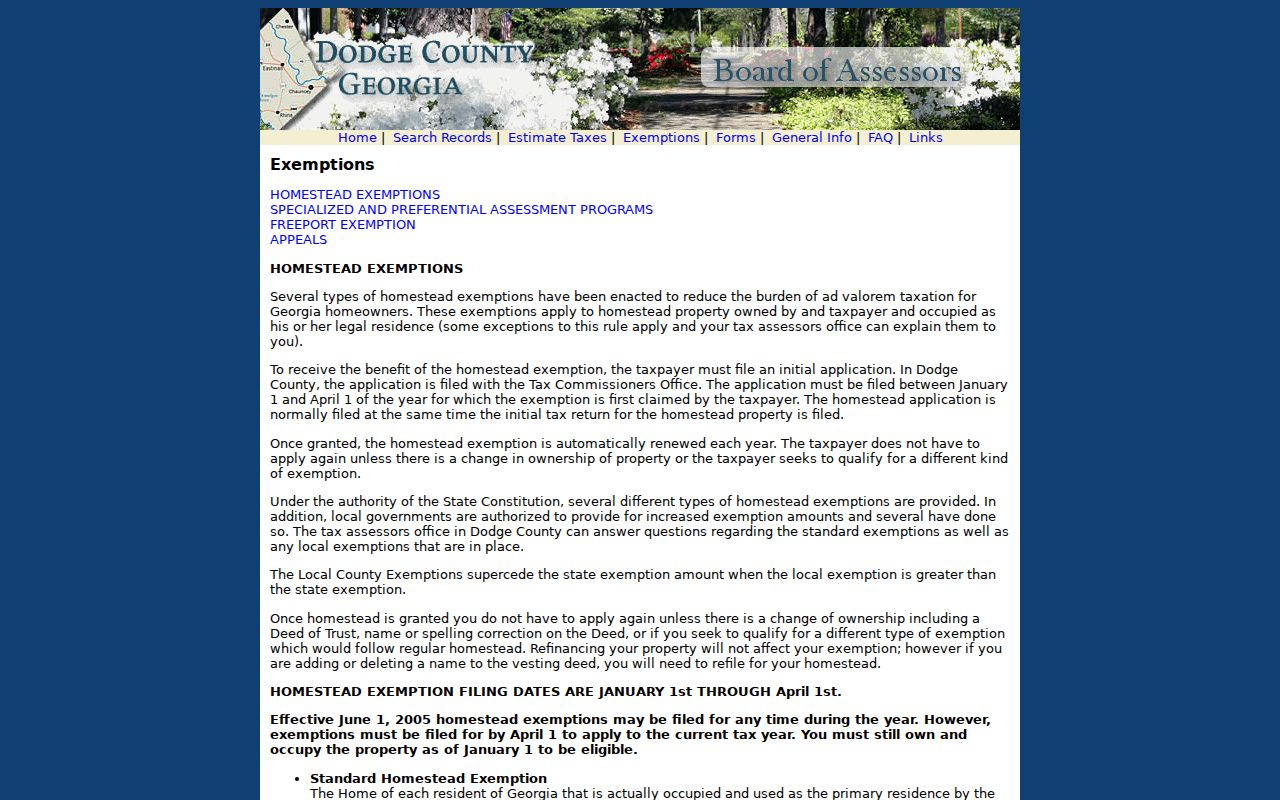
Use that page as a starting checklist. Then get the current form and deadline straight from the assessor before filing anything.
Look Up a Dodge County Tax Bill
The county links to a GovernmentWindow property-tax route for paying online. Treat that page as one channel among several, not the only source of bill information.
- Find the APN and value year through QPublic.
- Open the county's GovernmentWindow tax route or contact the Tax Commissioner at 5017 Courthouse Circle, Suite 104, Eastman, 478-374-2154.
- Match the owner, parcel, tax year, amount billed, and payment status.
- Compare exemptions against the assessor roll and ask the Commissioner about delinquency or tax-sale status.
- Assessed value
- The taxable percentage of the appraised value before applicable exemptions.
- Mill rate
- The rate applied per $1,000 of taxable assessed value.
- Homestead exemption
- Relief for a qualifying principal residence.
- Tax lien
- A claim connected to unpaid tax that must be checked with the current custodian.
Separate Delinquency From a Tax Sale
An unpaid balance, a recorded execution or lien, a published sale notice, and a completed tax deed are separate events in a chain. They are not one step. Check current status with the Tax Commissioner first. Then search the GSCCCA lien and deed systems and any Superior Court file when enforcement is disputed. A balance alone proves nothing about redemption rights or title.
Date Each Dodge Property Tax Figure
Dodge County property tax records can show several values that look alike but answer different questions. Fair market value and assessed value belong to a digest year. Exemptions shrink the taxable base for a qualifying account. Millage applies to that year's taxable assessment. The payment record reports what happened to the bill. Mixing years produces a misleading estimate.
The assessor states that QPublic reflects the most recently published tax digest. That wording sets no real-time update schedule after a sale or parcel split. Timing matters here. Write down the digest year shown, the notice date, the bill year, and the date the office confirmed payment or delinquency.
Appeal a Dodge County Assessment
For 2026 only, Dodge assessment notices were mailed June 19, with August 3 as the stated last day to appeal. The county accepts appeals by email, USPS, or the QPublic appeal module. An appeal can target value, taxability, or uniformity. It is not a payment dispute with the Commissioner. Bring useful evidence. Comparable sales, photographs, a recent appraisal, repair estimates, and consistent property facts all help.
Appeal window. The August 3, 2026 date applies only to that notice cycle. Read the deadline printed on the current annual notice and file with the Dodge Board of Tax Assessors through an accepted channel.
Request Records When the Portal Is Blocked
The assessor answers questions by phone, email, or in person. The office sits at 5018 Courthouse Circle, Suite 201, Eastman, weekdays from 9:00 a.m. to 5:00 p.m. Use 478-374-8122 or dodgeassessor@gmail.com. For a tax bill, payment history, or delinquency status, contact the Tax Commissioner directly. When a Dodge County record is not posted publicly, a formal request route exists. The custodian sheet and Georgia Open Records Act guidance from the Attorney General lay it out. Name the record, the parcel, and the year precisely.
Include the parcel number. Add the owner of record exactly as printed, the situs address, and the tax year you need. Ask whether an electronic copy is available and how the charge will be estimated. Under Attorney General guidance, a custodian generally responds within three business days. The response produces the record or explains timing and cost.
An open-records request is not an appeal. It can surface an appraisal record, property card, or digest entry. But the appeal still has to go through the channel and deadline printed on the notice. Requesting payment history will not pause collection either.
Keep every response alongside the notice and bill for the same tax year. Note who the custodian was and when you asked. Also note when the document arrived. Record whether it came from the assessor, commissioner, board, or court. That paper trail keeps later comparisons dependable.
Note: Confirm current due dates, millage, payment fees, and appeal deadlines with the county, since each can change.