
Understand Dodge County Deed Records
The Clerk of Superior Court files Dodge County deed records. Each deed names the parties and describes the land. It also states the transfer language and carries execution details plus a recording reference. Sales are only part of the picture. An ownership trail can turn on a foreclosure, tax sale, estate, easement, timber contract, or security instrument. So widen the property search beyond warranty deeds.
| Deed Type | What It Does | Common Use |
|---|---|---|
| Warranty deed | Transfers title with stated covenants | An arm's-length sale |
| Quitclaim deed | Transfers whatever interest the grantor holds | Family, estate, or title cleanup |
| Security deed | Secures a Georgia real-estate debt | Financing and later cancellation searches |
| Executor or administrator deed | Conveys through estate authority | Probate-related transfer |
| Tax or sheriff's deed | Records a transfer following a statutory sale | Enforcement-related chain research |
A deed conveys an interest. Liens, releases, cancellations, and security deeds affect that interest instead. Read all related filings together to see what the owner of record actually holds.
Search Dodge Deeds in GSCCCA
Start with the GSCCCA name search. Select Dodge County from the county list first. The statewide index covers party names, grantor and grantee roles, and instrument types. It also lists recording dates and book-and-page references. You can also filter and sort the results. For a name of two characters or fewer, the form demands more detail: a county, an instrument type, and a one-year date range. That keeps very short name searches from flooding the screen. The interface itself is the deed-name screen used for Dodge County deed records.
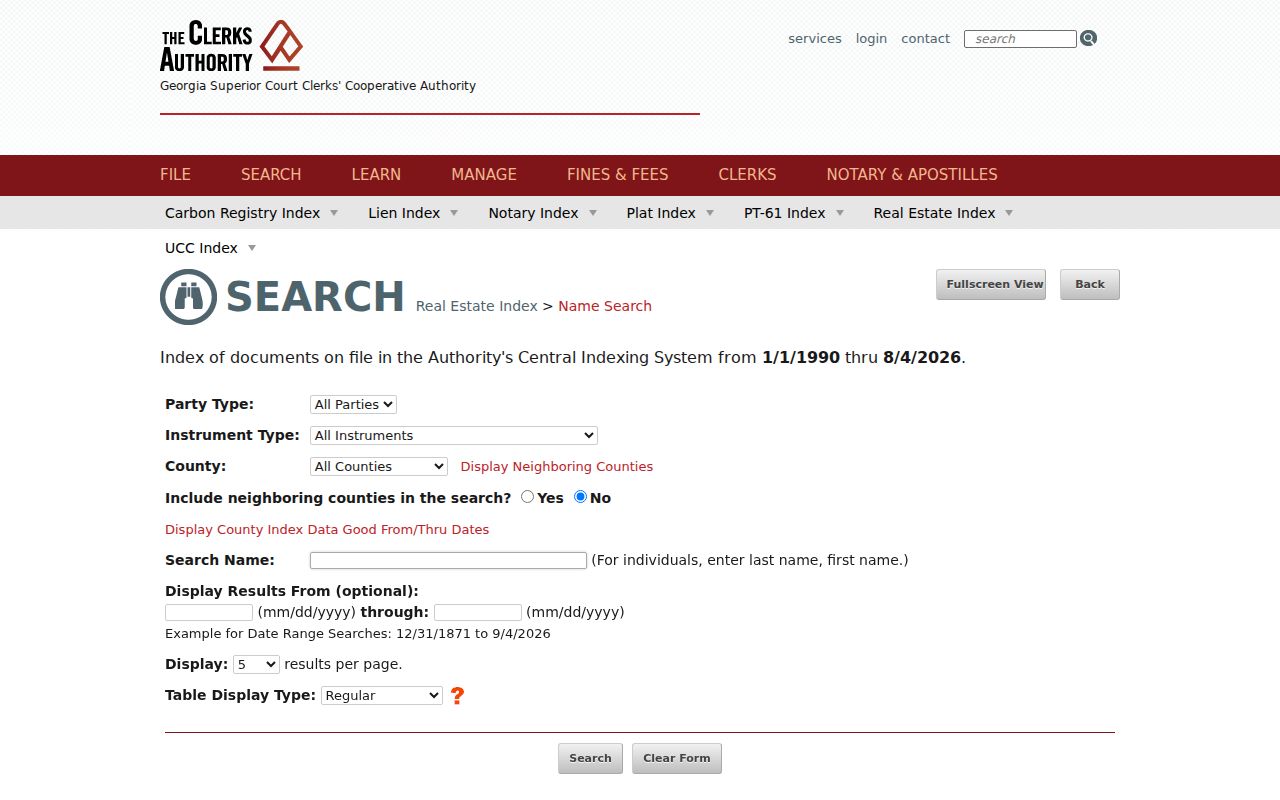
Before you open or order a deed image, note the exact indexed spelling of each name. Also record the party role, document type, recording date, and the book-page or instrument reference for that Dodge County deed.
Resolve Dodge's Three Coverage Statements
Dodge County has three different statements about deed coverage. They do not mean the same thing. The local clerk's links page describes historical deed records from 1968 through 1990. The GSCCCA name-search form, in turn, presents a central index starting in 1990. A separate GSCCCA service description pushes indexed coverage to at least January 1, 1999. Treat each claim on its own terms.
| 1968-1990 | Local historical-record label; ask the clerk what index and images it includes. |
|---|---|
| 1990-current | Date shown by the public name-search interface. |
| 1999-current | Separate statewide service-description baseline. |
Note: Check the actual book or image run before treating an online no-result as a missing deed.
Open Dodge Deed Book References
A book and page reference opens a straight path. When an assessment card, older deed, plat, or court filing hands you those numbers, the GSCCCA book-page search sidesteps the guesswork of party names. Type the reference in exactly. Dodge County deed records then come back as a recorded image. Read it closely. Confirm the county, the document type, both parties, the recording date, and the full legal description before relying on what it shows.
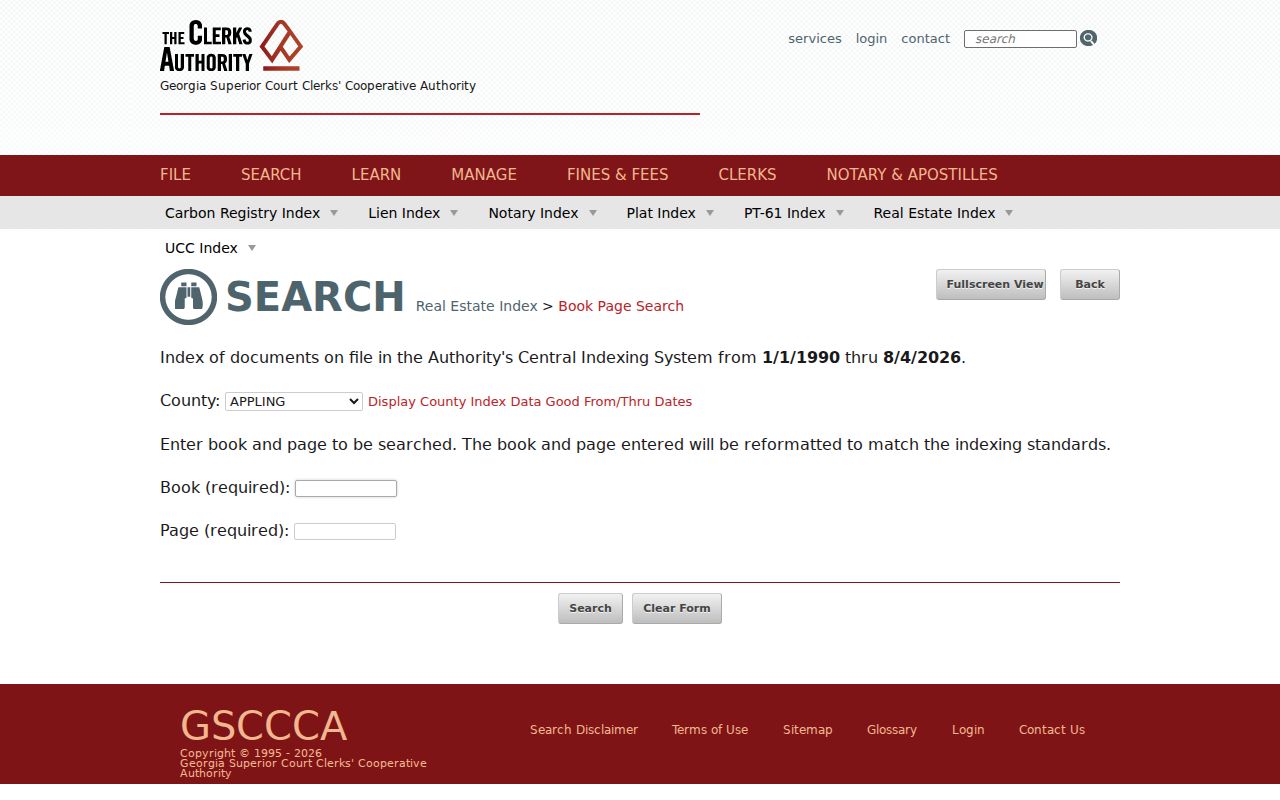
Party-name searches stumble when initials, married names, corporate entities, or old spellings blur who held title. Book-and-page references sidestep that problem entirely for Dodge County deed research.
View Dodge Deed Record Images
Finding an index entry and pulling the actual image are separate steps. The GSCCCA account page lays out the account tiers. It also lists a $0.50-per-page charge for printing. That fee is subject to change. Review the current terms before putting money into an account. Pricing and product access shift over time. Knowing the difference keeps a free index lead from being mistaken for paid image access.
No image available, or need a certified copy? Take the book-page or instrument reference straight to the Dodge County clerk and request the deed record there. The clerk's office can produce the document even when online printing falls short.
Follow Dodge's Grantor-Grantee Chain
Every deed names a grantor who gives up an interest and a grantee who takes it. To rebuild a Dodge County chain, work from the legal description and the recording reference, not from names alone.
- Find the current owner's acquisition deed with that owner as grantee.
- Read the grantor, legal description, and prior book-page reference.
- Search that grantor as an earlier grantee and confirm the same land.
- Repeat until the online coverage ends, then move to the clerk's deed books or archive microfilm.
- Grantor
- The party transferring an interest.
- Grantee
- The party receiving an interest.
- Chain of title
- The linked sequence of recorded transfers affecting the land.
- Book and page or instrument number
- The clerk's locator for a filing.
Connect Dodge Deeds and Plats
A solid chain rarely stops at warranty deeds. Dig into the GSCCCA plat index for subdivision and survey leads. Then chase the easements, rights-of-way, restrictions, boundary agreements, security deeds, cancellations, and releases. Tie them to the same parties or legal description. One caution: the property-subdivision dropdown leaves Dodge out. That is a display gap, not proof a record is missing. Rely on the name, plat, book-page, and clerk routes instead.
Dodge Deed Records Span Two Paths
Dodge County deed records arrive through two different doors. GSCCCA lists Dodge among participating counties for electronic filing. The filings cover deeds, plats, liens, and UCC records, with an effective date of September 4, 2026. Participation does not mean every older deed image is online. The county was created in 1870 from Montgomery, Pulaski, and Telfair counties. So a chain running past 1870 may continue in a parent-county deed book.
For older volumes, the Georgia Archives county-card index is the place to look. So are the archives' county-record microfilm collection and the FamilySearch Catalog. Copy every citation exactly. Keep the original spelling, county, book, page, and archive identifier intact.
Monitor New Dodge Property Filings
GSCCCA FANS watches for new filings for free. It matches names, addresses, and document or book-page details you choose. The service launched in 2023. Its 2024-2025 accomplishments report counted nearly 85,000 users and about 254,000 alerts by June 30, 2025. Those numbers are statewide rather than Dodge County counts. Treat any alert as a lead worth checking. Do not treat it as a title examination or a fraud decision.
Read Timber and Railroad Instruments Carefully
Dodge County grew up around timber and railroads, and its oldest deed records show it. The assessor's local history tells part of the story. The New Georgia Encyclopedia also ties the county's land story to mills, depots, and turpentine camps. That history changes how a property search should work. An ordinary owner-name query will miss plenty. For an older tract, pair the people in the chain of title with mill names and timber companies. Add railroad terms too. A timber deed or timber lease can still shape what the land includes. That holds even when it is not the conveyance you set out to find.
Record what you actually see. Note the instrument type, the original spelling of every name, the legal description, book and page, and the recording date. Also note the institution holding the deed records. A newspaper clipping or a historic landmark can point you toward a parcel number or a plat. But it cannot replace the recorded instrument itself. That matters most around early Eastman descriptions. Those often lean on a railway feature, a building, or a business name rather than a modern street address.
Pair Estate and Court Events With the Deed
An executor's deed or a sheriff's deed seldom tells the whole story. A tax deed or administrator's deed works the same way. So pair the conveyance with its court paper. Match an estate transfer to the probate file. A foreclosure or sheriff's sale needs more than one paper. Match it to the court order, the sale record, the security deed, and any later release. Dodge Superior Court is reachable through Georgia Courts eAccess. The local provider route may require an account. When that route stalls, the clerk's counter is the practical answer.
Names can shift between a court caption, an estate file, and the recorded deed. Match the property description and the recording references. Don't assume two similar names point to the same owner or tract.
Get a Copy of a Dodge County Deed
Images can be inspected through a GSCCCA account, and the account material lists a $0.50-per-page printing charge. For an official copy, ask the Dodge County Clerk of Superior Court directly. Ask what identifying information is needed. Ask about the copy fee, certification charge, payment method, and return envelope currently required. The office sits at 643 Pearl Bates Avenue, Eastman, GA 31023, and the phone is 478-374-2871. Mail should go to PO Box Drawer 4276.
If online images stop short, give staff the names, the approximate recording year, the deed type, and any book-page reference. That lets them search the vault or older media for you.
Recorded, not guaranteed. A Dodge County deed-index hit shows that an instrument was indexed. It does not establish a complete chain, resolve unrecorded interests, or supply a title opinion.
Compare the index entry with the land itself before ordering anything. Match the legal description, the subdivision and lot, the acreage, adjoining owners, the prior deed reference, and the execution date. An older deed may omit the street address you know. One grantor can convey several tracts in separate instruments recorded the same day.
Ask whether the copy should be plain or certified. A plain copy suits most research. A certified copy carries the clerk's certification, which some uses specifically demand. Get a fee quote from the clerk for local copies. Do not apply the statewide online printing price to a counter request.
For a mailed request, confirm the payee, the accepted payment form, and any return-postage requirement. Ask whether staff will search from names and approximate dates. Include a daytime contact number in case the book-page reference is wrong. Never send payment to an address pulled from an unrelated office directory.
Keep the envelope, the receipt, and the certification page with the deed image. Note where the copy came from and when it arrived. The deed may reference an attached exhibit or plat. Confirm every referenced page is included before treating the copy as complete.
Use the Counter and Open-Records Route
The clerk's counter handles index questions, certified copies, and books that never appear online. Describe an existing record when you go. Staff cannot determine ownership for you. For other public records, Georgia's Open Records Act lays out a custodian request process. But it does not force the county to build a new report. A deed search tied to a purchase, boundary dispute, heir matter, or easement question deserves careful handling. Review it with a Georgia attorney or title professional.
Note: Confirm current GSCCCA coverage, image access, and clerk-copy fees at the time of the request.