
Build a Dodge County Former-Owner Timeline
Start with the present grantee. Make one row per transfer. A useful timeline captures the date, the parties, the deed type, the book and page, and a short legal-description match, which keeps any gap from hiding.
| Period | Likely record path | What to preserve | Main caution |
|---|---|---|---|
| 1990 to current screen | GSCCCA name and book/page indexes | Grantor, grantee, type, date, book/page | Dodge image run not confirmed |
| 1968 to 1990 label | Dodge clerk historical link | Exact book or project reference | Label does not promise complete images |
| 1870 to 1967 | Clerk books, microfilm, plats, tax digests | Original spelling and legal description | Online availability is unconfirmed |
| Before 1870 | Montgomery, Pulaski, and Telfair records | Parent county and archive identifier | Dodge County did not yet exist |
A GSCCCA service description says coverage runs from at least 1999. The form's own start date is 1990. Those are distinct claims about Dodge County deed records, so ask the clerk which books and images fill the interval between them.
Dodge County’s Three Online Cutoff Statements
Three cutoffs compete in Dodge County property records. The GSCCCA name search gives January 1, 1990 as its start. A service page says at least January 1, 1999. The Dodge clerk links page says "1968 - 1990." None proves a seamless image run. Record which interface supplied each hit. If a previous owner disappears at a cutoff, call the clerk at 478-374-2871 with the last sound book/page and legal description in hand.
Search More Than Warranty Deeds in Dodge County
A backward chain can pass through many instruments. Quitclaims, gift deeds, estate transfers, foreclosures, sheriff's sales, tax sales, trustee's deeds, right-of-way grants, boundary-line agreements, and court orders all move land in Dodge County. Search instrument types broadly. A security deed or release may explain an encumbrance. When parties change without a routine sale, branch into probate or Superior Court files, then return to the land index for the recorded instrument that touches the parcel.
Walk the Dodge County Deed Chain in Reverse
Your newest matched deed names the prior owner. Search again with the land itself, not the name, as the constant.
- Find the current owner’s acquiring deed with that owner as grantee.
- Copy its grantor, date, book/page, type, and legal description.
- Search that grantor as an earlier grantee and verify the same tract.
- Repeat until the index ends, then continue in clerk books or microfilm.
- Grantor / grantee
- The transferring and receiving parties.
- Reverse index
- A route organized around grantees for locating an acquisition.
- Chain of title
- The ordered sequence of instruments affecting the tract.
- Quitclaim / warranty
- Different deed forms that must be read, not treated as equal promises.
Use Dodge County Plats When Addresses Change
A modern APN can hide a parent tract. Search the GSCCCA Plat Index by party or book/page, then match subdivision, lot, block, acreage, and boundary calls. Dodge is absent from the optional property/subdivision dropdown. Do not rely on that form alone. For any split, merger, or replat, follow the parent parcel and every legal-description reference it carries. An old deed may carry no modern situs address at all.
Before 1870, Follow the Land Beyond Dodge County
Dodge County was born in 1870. Its parents were Montgomery, Pulaski, and Telfair. A chain that predates creation may continue in one of those parent-county deed books. The Georgia Archives tax-digest collection, FamilySearch access through the Archives, and clerk microfilm all offer leads into that earlier period. The lesson for older ownership work is simple. A missing Dodge deed may simply live in the correct earlier jurisdiction rather than being lost.
Library Clues Can Reconnect Dodge County Previous Owners
The regional Green Book finding aid catalogs Dodge sources. It lists Dodge marriages, cemeteries, clippings, and community news. Each can surface an heir, a married name, an estate, or a former road name when the deed index stalls. A clipping or headstone is only a lead. Confirm every former owner with a recorded deed, probate order, tax digest, or other official record tied to the property.
Preserve a Research Log for Every Dodge County Transfer
Log everything for every owner. Save the search role, exact spelling, county choice, date range, instrument type, and recording date. Add book/page and the legal-description phrase you matched. Note the image or certified-copy source only once it checks out. This discipline matters because initials, married names, estates, timber companies, and repeated family names can pull a name-only chain toward the wrong land in Dodge County.
The GSCCCA screen can return neighboring-county results. A nearby name proves no Dodge conveyance. Match two stable identifiers. The legal description plus a book/page cross-reference makes the strongest pair. When a deed cites an earlier deed, plat, release, or court order, follow that citation before stepping back another generation.
The official GSCCCA name-search screen has the right fields. Party role, county, date range, and instrument type all appear there, so use them to narrow a prior owner, then verify the result against the clerk-held instrument rather than treating the form itself as title evidence.
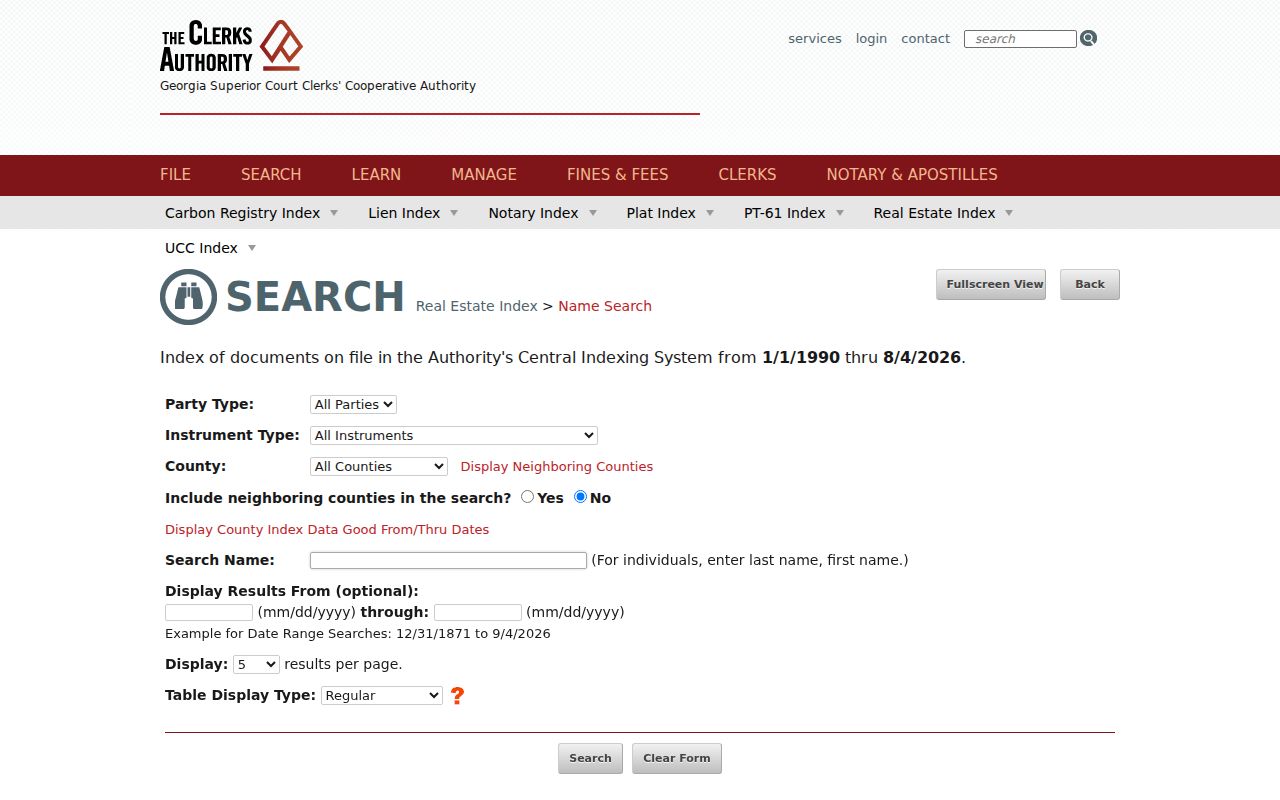
Use party-role and county controls to narrow the search. Then verify the result against the clerk-held instrument, since the form itself is not title evidence.
Handle Estate, Foreclosure, and Replat Branches in Dodge County
Deeds tell only part of the story. A Dodge County chain often branches in ways a name search will miss. When an owner died, probate records may name an executor or administrator. A deed issued under court order or from the estate carries the land forward. Search the decedent and the representative together. Then require the same legal description every time. A will can explain who held authority. It may never serve as the recorded conveyance in the chain of title.
Foreclosure adds its own branches. Sheriff's deeds, tax-sale deeds, trustee's deeds, and security-deed releases each exist on the record. Each one leaves a distinct mark. Record the instrument type exactly as filed. When the filing cites a related case, security deed, or release, pull that document too. Resist reading a former owner's debt troubles into an index label. The record proves only what that particular document states, nothing more.
Replats complicate things further. One old Dodge County tract can become several current parcel numbers after a split. Work from today's parcel backward to its parent description, plat book and page, boundary-line agreement, or earlier tax map. Follow every branch until each piece of land is accounted for. The method takes longer than a name search. It also keeps a previous-owner timeline from silently jumping between tracts.
How Far Back Dodge County Former Owners Can Be Traced
The public web route is only one layer of Dodge County property records. Clerk books and microfilm hold the pre-digital era. Archives preserve older tax and county materials, and parent-county books may carry the chain back before 1870. Keep the original spelling intact. Record the source institution, image identifier, recording date, and legal description at every step. That keeps the property chain verifiable.
Coverage limit. The online index does not establish the oldest Dodge County owner record. Older former owners may require clerk books, microfilm, archives, and pre-1870 parent-county research.
A reconstructed public chain is not a title opinion. Use former-owner research for land history, heirs, and lawful diligence, never to track or harass a living person.